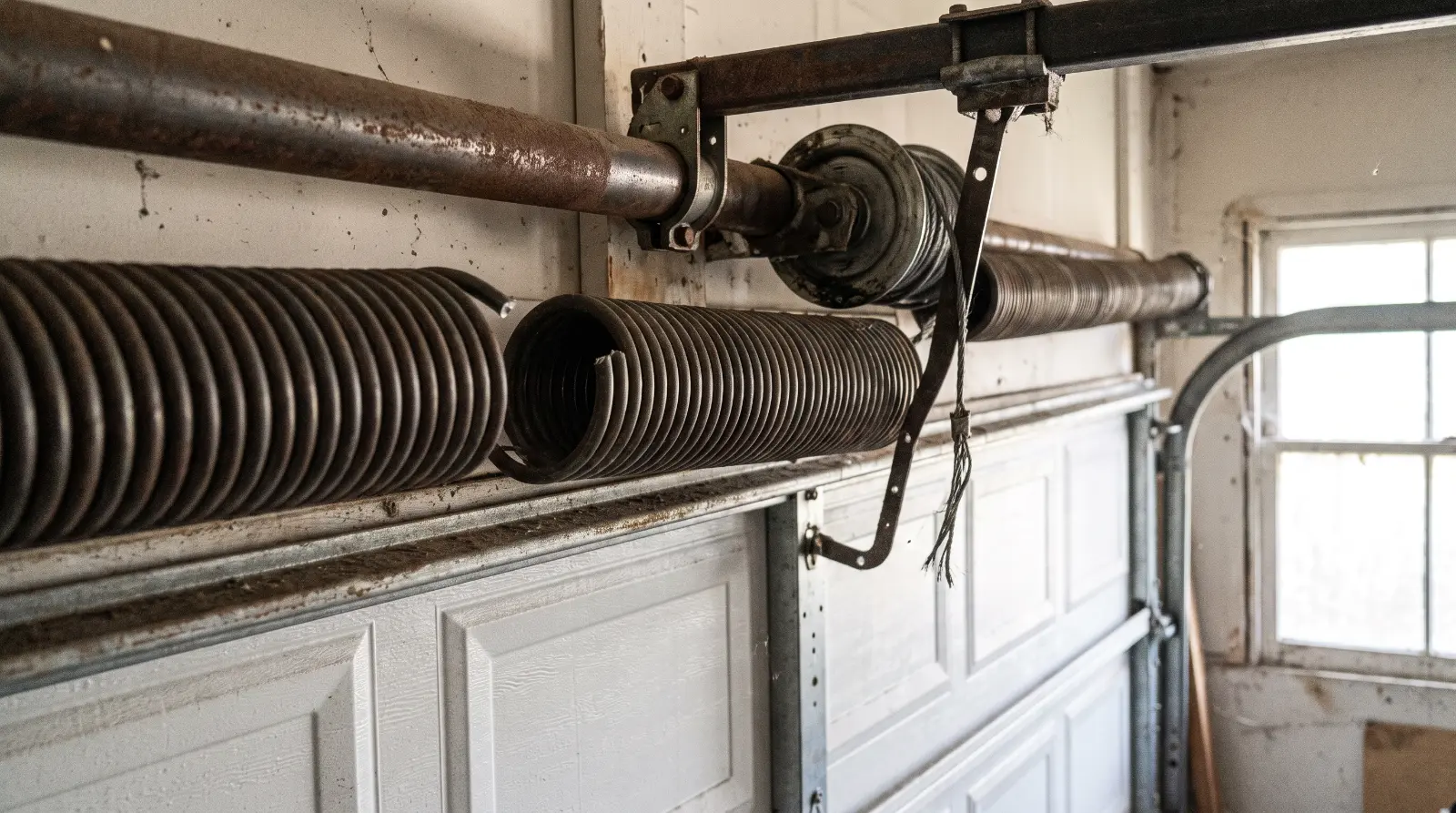
Garage door springs do the real lifting. A typical two-car steel door weighs somewhere around 150 to 200 pounds, and an insulated or wood door can weigh a good deal more. The springs balance that weight so the opener, or your arm, only has to guide it. When a spring breaks, the door suddenly weighs everything it really weighs, and the opener usually can't lift it.
If you think a spring has broken: stop using the opener, don't try to lift the door by hand, don't pull the red release cord if the door is open, and keep kids and pets out of the garage. Spring work is not a do-it-yourself job.
How to tell a spring is broken
- A bang like a gunshot from the garage, often when nobody is touching the door. Springs usually break while the door is closed, because that's when they're wound the tightest.
- A visible gap in a torsion spring on the bar above the door. The coils will look split apart.
- The opener strains, lifts the door a few inches and stops, or the door goes up crooked.
- The door slams down or drops fast when it's released.
- Loose cables hanging at the sides. When a spring lets go, the cables often lose tension and can come off their drums.
Torsion springs and extension springs
Most homes around Independence built from the 1980s on, and nearly every newer home in Blue Springs, Lee's Summit and Grain Valley, use torsion springs: one or two coiled springs on a steel bar above the door. They're quieter and more controlled than the older style.
Many older homes, including postwar ranches and some of the detached garages near the Truman neighborhood, still have extension springs, which stretch along the horizontal tracks on each side. They should always have a safety cable running through the middle so that a broken spring can't fly across the garage. If yours don't, mention it when you call.
Some older one-piece doors swing up and out on big side springs and pivot arms. Those are a different setup altogether, and not every company works on them, so describe the door clearly when you call.
Why springs break
Every spring is rated for a certain number of open-and-close cycles. A common standard spring is rated for about 10,000 cycles. Open and close the door four times a day and you'll use about 1,500 cycles a year, so a standard spring often lasts somewhere around six to eight years. Families who use the garage as the main door wear through springs faster.
A few things speed it up:
- Rust and humidity. Kansas City summers are humid, and an unconditioned garage gets damp. Surface rust creates friction between the coils.
- Hard freezes. A worn spring often snaps on one of the first cold mornings of the season.
- A heavier door than the springs were sized for. Adding insulation, a new window section or a decorative overlay changes the weight.
- No maintenance. A light coat of garage door lubricant on the coils once or twice a year helps.
Heard the bang?We'll try to connect you with an independent garage door company that works your ZIP code.
Call (816) 422-DOORWhat a spring repair visit usually involves
A technician will typically:
- Secure the door so it can't move, then unwind the remaining tension safely
- Measure the old springs and the door's weight to choose the right replacement
- Replace the broken spring, and usually its partner on a two-spring door
- Check the cables, drums, center bearing and end bearings for wear
- Wind and balance the new springs so the door stays put halfway up
- Test the opener's force and reversing settings
Ask whether they're installing standard springs or higher-cycle springs, and what that means for how long they should last. If your door gets heavy daily use, higher-cycle springs may be worth asking about.
How to check your door's balance once it's fixed
With the door closed, pull the release cord to disconnect the opener, then lift the door by hand to about halfway and let go gently. A balanced door stays roughly where you leave it. If it falls or rises on its own, the springs need adjusting. Reconnect the opener afterward by running it until it latches. Do this a couple of times a year, and before winter.
Signs your springs are getting tired
- The door feels heavier than it used to when lifted by hand
- The opener sounds like it's working harder
- The door won't stay halfway up
- You can see stretched or uneven gaps in the coils
If you notice these, it's better to call before the spring lets go with the car inside. Quick answers on springs and other common problems are in the garage door FAQ. Not sure whether it's worth fixing an old door at all? Read repair or replace.
Spring repair questions
Can I replace a garage door spring myself?
We don't recommend it. A wound torsion spring stores enough energy to break bones, and the work needs proper winding bars and experience. Spring work is the one garage door job where a mistake can seriously injure you.
Should both springs be replaced if only one broke?
Most technicians recommend it on a two-spring door. The springs were installed at the same time and have done the same number of cycles, so the other one is usually close behind. Ask the company what they suggest and why.
How long does a spring repair take?
A straightforward torsion spring replacement often takes around an hour once the technician is on site. Older doors, extension spring conversions or damaged cables can take longer.
Why do springs seem to break in cold weather?
Steel gets more brittle in the cold, and a spring that is already worn from years of cycles often lets go on one of the first very cold mornings. Cold isn't the root cause, wear is, but a hard freeze is often the last straw.