A garage door that won't move is stressful, especially when your car is on the wrong side of it before work. The good news is that a lot of stuck doors have a simple cause, and the ones that don't usually give you warning signs you can spot from a few feet away. Work down this list in order and stop the moment you find something on the "leave it alone" side.
Stop right away if you heard a loud bang, see a cable hanging loose, or the door is crooked in its opening. Those point to a broken spring or cable, and the door can fall. Keep people and pets clear and call for help.
1. Check the power and the remote
Start with the boring stuff, because it fixes more doors than you'd think. Is the opener plugged in, and does its light come on? Try the wall button. If the wall button works but the remote doesn't, the remote battery is the likely culprit. If nothing works, check the outlet with a lamp and look for a tripped GFCI outlet in the garage or a tripped breaker in the panel. Spring and summer thunderstorms around Kansas City knock power out often enough that a reset breaker is a real possibility.
Many openers also have a lock or vacation button on the wall control. If it's on, the remotes are ignored. The opener light may blink to tell you.
2. Look at the safety sensors
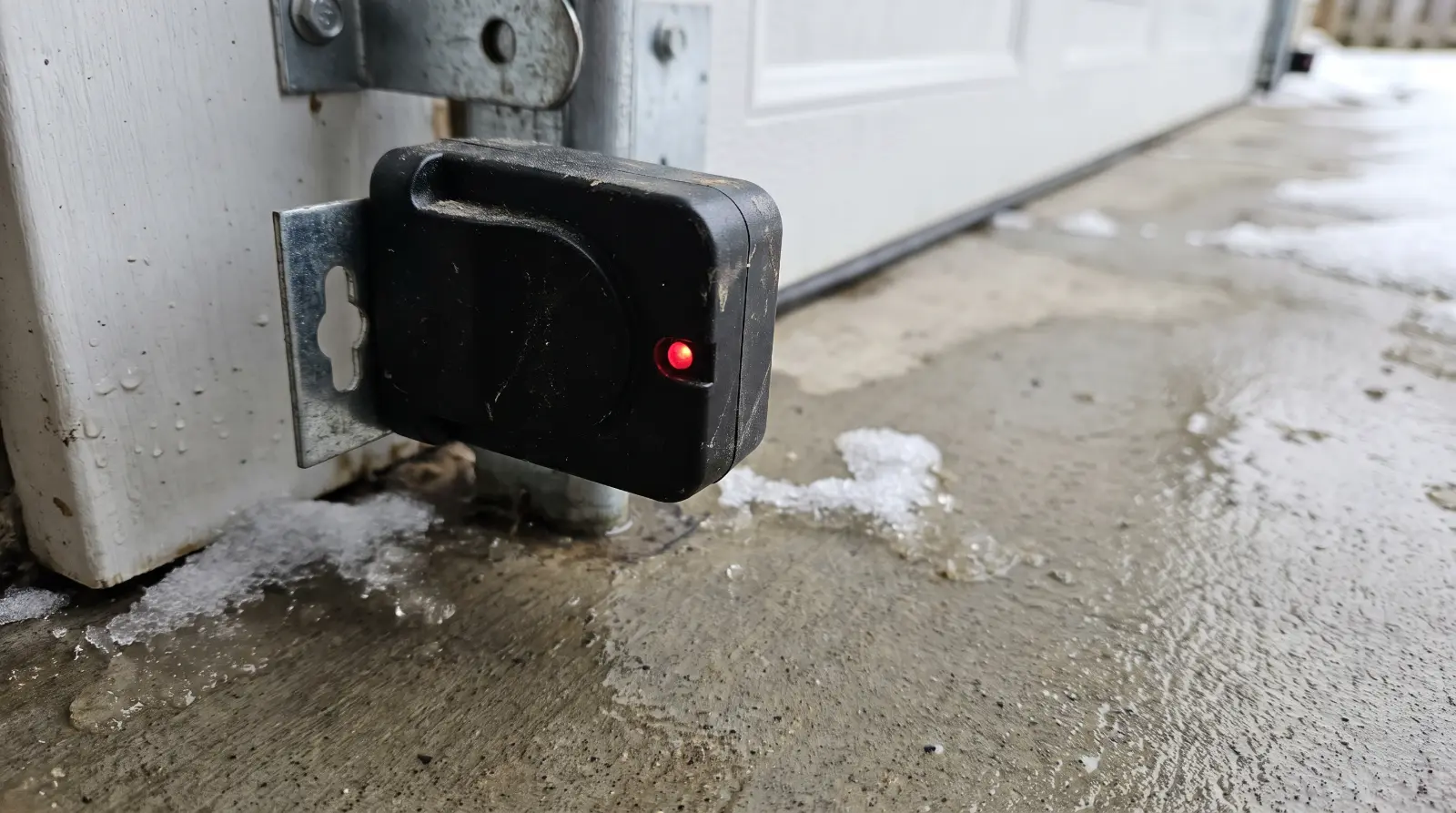
If the door starts down and then reverses, or the opener light blinks and the door won't close at all, look at the two small sensors on either side of the opening, a few inches off the floor. Each has a small light. Both should be steady. A blinking or dark light usually means they're out of line, dirty or blocked.
- Wipe the lenses with a soft cloth. Dust, spider webs and wet leaves are common.
- Move anything in the path: trash cans, a bike tire, a bag of salt.
- If one sensor is pointing at the floor, loosen its wing nut, aim it at the other one until both lights hold steady, and tighten it again.
- Direct afternoon sun into a sensor can confuse it. A west-facing garage on a summer evening is a classic case.
3. See if the door is disconnected from the opener
If the motor runs and the chain or belt moves but the door doesn't, the door has probably been released from the opener carriage. That's what the red cord does. Someone may have pulled it during an outage. Before you reconnect anything, check that the door moves smoothly by hand and stays put halfway up. If it does, run the opener and it will usually latch back on by itself.
If the door is very heavy, drops when you let go, or won't stay halfway up, don't reconnect it. That's a spring problem, and the opener isn't built to lift the full weight of the door.
4. Listen for signs of a broken spring
A torsion spring that breaks usually goes with a bang, often when nobody is using the door. Look at the bar above the door. If you see a gap of a couple of inches in one of the coiled springs, it's broken. On older homes with springs running along the side tracks, look for a stretched or snapped spring and check that its safety cable is still threaded through. Our broken spring guide covers what happens next.
5. Check the tracks, rollers and cables from a distance
Stand back and look at both sides of the door. Is it level? Are the rollers sitting in the tracks? Is a cable slack or hanging off its drum at the top? A door that jumped its track or has a broken cable needs a technician, because the cables are holding hundreds of pounds of spring tension. The cables and tracks page explains what to look for.
6. Think about the weather
In winter, a door that won't open after freezing rain is often frozen to the slab. In summer, steel can expand enough that a door already slightly out of adjustment starts to bind. After a hail or wind storm, a dented section or bent track can stop the door cold. See the pages on ice and winter and storm damage.
What you can safely do, and what you shouldn't
| Fine to do yourself | Leave for a technician |
|---|---|
| Change remote and keypad batteries | Anything involving springs or the spring bar |
| Reset a tripped breaker or GFCI outlet | Cables, bottom brackets and cable drums |
| Clean and realign the safety sensors | Putting a door back on its track |
| Clear ice or debris from under the door | Adjusting the opener's force settings past the manual's range |
| Reconnect the opener if the door is balanced | Replacing bent sections or a damaged opener rail |
Door still stuck?We'll try to connect you with an independent garage door company that works your ZIP code.
Call (816) 422-DOORWhat to tell the company when you call
A few details help the company you reach figure out what they're dealing with before they arrive:
- Whether the door is stuck open, stuck closed or partway
- Any noise you heard: a bang, grinding, a hum with no movement
- Whether the door is level or crooked
- The opener brand if you can see it, and roughly how old it is
- Single or double door, and steel, wood or something else
If your car is trapped inside, say so. It helps the company plan, even though no one can promise a specific arrival time.
Common questions
Why does my garage door go down and then go right back up?
Usually the safety sensors. If the two small eyes near the floor are dirty, knocked out of line or blocked, the opener reverses the door for safety. Check for a steady light on both sensors. If the door reverses only when it touches the floor, the close force or the down limit may need adjusting, or ice or debris is under the door.
The opener runs but the door doesn't move. What happened?
Either the door is disconnected from the opener (someone pulled the red release cord), the spring is broken, or a gear inside the opener has stripped. If you heard a bang earlier, suspect the spring and don't try to lift the door by hand.
Is it safe to keep using a door that's sticking?
No. A door that drags, jerks or stops partway is telling you something is binding or broken. Running the opener against it can bend the door, strip the opener gear or snap a cable.